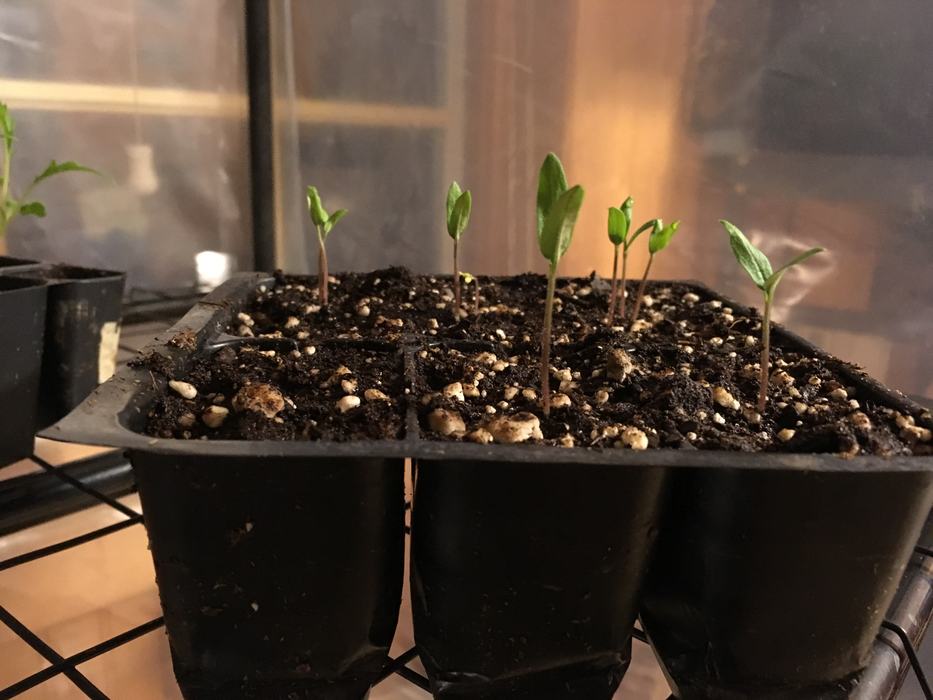
Annual plants for home gardens are commonly started from seeds to encourage early flowering or fruit production. For the most part, it is a straightforward process. However, there are important details that should not be overlooked when going about starting these plants.
The first step is to choose seeds that have been stored properly or are not too old. Seeds can remain viable for years, but viability varies based on storage conditions, age, and seed physiology. If you are uncertain about old seed, try performing a simple germination test. Wrap seeds in wet paper towel, keeping them very moist, and count how many germinate after several days. This will not work with some pelletized seeds, and it can be difficult with very large, hard seeds.
Next, choose clean, sterile pots or trays and sterile media. Seedlings are vulnerable to fungal disease at a very young stage and planting in sterile pots helps reduce the risk of fungal attacks. If you are reusing pots or trays from previous years, dip them in a 1:9 bleach to water solution for five minute or more to sterilize. Fill the trays once dry. Choose a sterile, pre-mixed fine germination media or make your own by thoroughly mixing of peat moss or fine particle pine bark, in equal part with perlite, vermiculite, or a combination of the two. Since most germination media is low in fertility, fertilize seedlings with a dilute soluble fertilizer or fish emulsion once they have grown “true” leaves. Full doses of fertilizer can burn seedlings. Apply one quarter to one half the recommended rate, every 7-10 days, while seedlings are small. If you purchase a seed starting mix with fertilizer, you may not need to fertilize seedlings. Do not add raw manure or young compost to media as they are not sterile and the ammonium in these can burn young seedlings.
There are many different styles and sizes of seeding pots and trays. Keep in mind that if you are only going to grow your seedlings for 4 weeks before you transplant them, they might not need that much space in a tray. Fill each tray or cell near capacity with media, and wet the media before sowing seeds. Open trays or flats can hold many plants and allow roots to grow throughout the media, but require more care when transplanting as you must separate roots of individual plants. When using trays with individual cells, plant one to two seeds per cell. Cover each seed with a light layer of germination mix; approximately two to four times the diameter of the seed. Avoid sowing seeds that will be transplanted at different times in the same tray. One easy way to do this, if you plant small quantities of many different types of plants, is to utilize removable inserts, such as “6-packs”, within a larger tray.
Temperature, moisture, and lighting are important factors in seedling success. Many seeds germinate best between 65 and 85 F. Place trays on an electric germination mat for added warmth. It is critical to keep the media moist during germination. If possible, create a humid environment around the trays by placing in a germination tent or covering them with a clear plastic tray. Remove any plastic cover as soon as the first seed germinate. Seedlings should be kept between 60 to 70 F during the day and 55 and 60 F at night.
Check the seed packet for instructions on lighting.